

Triangular placement: ~40% democratic (genuine electoral competition, guardian council filter) · ~35% oligarchic (IRGC economic empire, clerical establishment) · ~25% contested (sovereignty defense vs. epistemic enclosure)
Genealogical flags: Achaemenid civilizational depth (539 BCE–) · 1953 CIA-MI6 coup as foundational rupture · Revolutionary sovereign republic (1979–) · Constitutional guardian republic architecture · 45 years of sustained imperial economic warfare
The most analytically underrated polity in the Western discourse. Every standard account begins with the Islamic Revolution of 1979. The honest account begins with Cyrus the Great in 539 BCE and asks what a civilization of that depth looks like when assessed without the Aeschylean distortion that has structured Western perception of Persia for two and a half millennia. This assessment attempts that honest account.
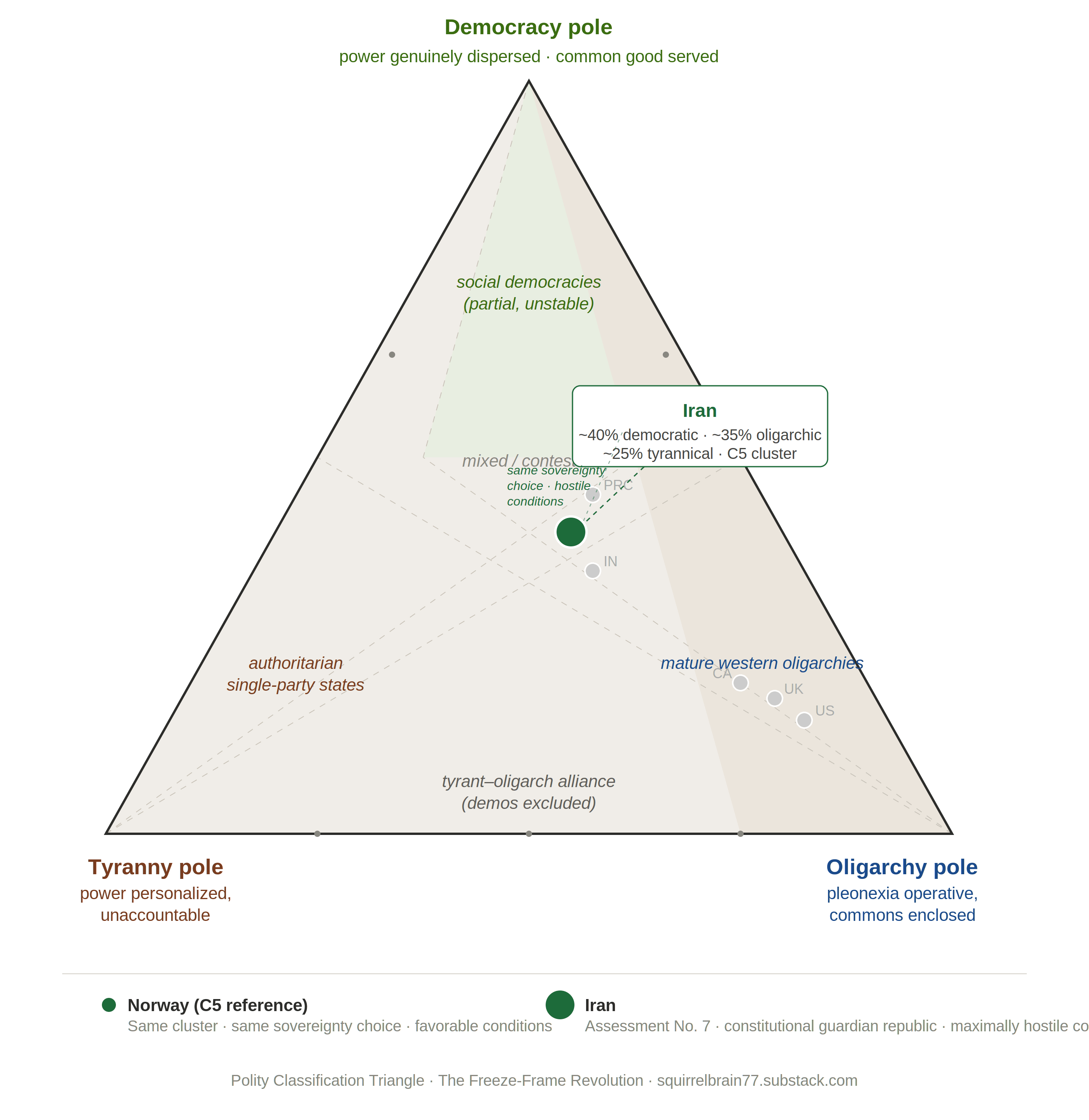
Figure 1. Polity Classification Triangle — Iran in C5 petrostate cluster alongside Norway · same sovereignty choice, maximally hostile conditions · note dashed line connecting Iran and Norway as the cluster’s analytical comparison pair
“The heritage of Cyrus was the heritage of human understanding, tolerance, courage, compassion and above all, human liberty.”
— Princess Ashraf Pahlavi, presenting the Cyrus Cylinder replica to the United Nations
October 14, 1971 · The replica has sat in the hallway between the Security Council and ECOSOC chambers ever since · The irony that names itself
I. The Civilizational Foundation: Before Aeschylus
Any honest assessment of Iran must begin by naming and refusing the distortion through which Western culture has perceived Persia for two and a half millennia. The source of that distortion is a single theatrical performance: Aeschylus’s The Persians, performed in Athens in 472 BCE, eight years after Salamis. It is the oldest surviving Greek tragedy and it is a piece of war propaganda, written by a man who fought at Marathon, presenting the Persian Empire as the embodiment of oriental hubris and despotism crushed by the virtuous freedom of the Greek city-states. This framing — Persia as the eternal Oriental threat to Western liberty — has structured Western perception of what is now Iran through every subsequent century of cultural transmission. It reaches into the present moment: every Western account of Iranian governance, every sanctions justification, every military strike rationalization, carries within it the Aeschylean residue. The framework’s zhengming obligation is to name this residue and refuse it.
The historical reality, available in the primary sources that Aeschylus and his tradition systematically misrepresented, is considerably more complex and considerably less flattering to the Greeks. The Persian Empire under the Achaemenid dynasty was the largest, most administratively sophisticated, and in significant respects most genuinely tolerant political formation in the ancient world. It governed dozens of nations, languages, and religions under a system that permitted substantial local autonomy, did not impose Persian religion or culture on subject peoples, allowed conquered peoples to maintain their own laws and governance traditions, and built infrastructure — the Royal Road from Susa to Sardis, the postal relay system, standardized weights and measures — on a scale that the perpetually warring Greek city-states could not remotely match.
The Cyrus Cylinder of 539 BCE is the foundational documentary exhibit. Written in Akkadian cuneiform, discovered in the ruins of Babylon in 1879, now in the British Museum, it records Cyrus the Great’s conquest of Babylon and his subsequent governance policies. The academic translation documents: the restoration of temples whose sanctuaries had been in ruins; the return of deported peoples to their homelands; the relief of forced labor; and the permission for exiled communities to return and rebuild their sacred sites. These are the policies that led the biblical text to call Cyrus ‘the Lord’s anointed’ and ‘the shepherd of God’ — the Persian king who allowed the Jewish people to return from the Babylonian captivity and rebuild the Temple in Jerusalem.
The replica of the Cylinder that Princess Ashraf Pahlavi presented to the United Nations on October 14, 1971, has sat in the second floor hallway of the UN headquarters in New York ever since, translated into all six official UN languages, positioned between the Security Council chamber and the Economic and Social Council chamber. The framework’s zhengming act for this assessment is to name what that placement means: the founding human rights declaration of the civilization whose heirs have sat under the most comprehensive economic sanctions regime in modern history, watching the Security Council chamber on one side impose those sanctions and the Military Strike Committee on the other coordinate the military strikes, while their civilization’s declaration that all peoples are free to choose their religion and that no one should oppress any others watches from the hallway between them. This is not a metaphor. It is the documented physical arrangement of the building. The irony that names itself.
A note on the translation is required by the framework’s zhengming discipline. The version circulated in all six UN languages and widely quoted — containing phrases about imposing monarchy on no nation and resolving on no war to reign — is, as some scholars note, an expanded interpretation rather than a strict rendering of the cuneiform text. The academic translation is more modest in its explicit claims. The framework uses the academic translation and notes the scholarly debate honestly. The historically documented actual policies — religious tolerance, return of deported peoples, restoration of destroyed sanctuaries, relief of forced labor — are remarkable enough without enhancement. A conqueror who in 539 BCE permitted conquered peoples to maintain their religions, return to their homelands, and rebuild their temples was practicing a form of governance that the Western tradition, which built empires on the exact opposite principles, has never honestly acknowledged as the Persian civilizational inheritance it plainly is.
Persepolis — the ceremonial capital of the Achaemenid Empire, whose ruins sit outside Shiraz — was destroyed by Alexander of Macedon in 330 BCE in an act he subsequently regretted. The ancient sources record that Alexander burned Persepolis in a drunken celebration, urged on by the Athenian courtesan Thais, and that in the sober morning he recognized it as a disgrace. The destruction of Persepolis is the first documented case of Western military power destroying Iranian cultural infrastructure as an act of political symbolism. The US-Israeli strikes of 2026 that targeted Iranian libraries, universities, and cultural institutions are the most recent. The pattern is 2,356 years old.
The Persian poetic tradition is the civilizational exhibit that the Western account most consistently fails to engage. Hafez, Rumi, Omar Khayyam, Ferdowsi — these are not the names of a peripheral literary tradition. Rumi’s poetry is the best-selling poetry in the United States, in translation, in the twenty-first century. Ordinary Iranians memorize Hafez in the way that educated English speakers quote Shakespeare, except that the practice of opening Hafez at random for guidance — fal-e Hafez — is a living social practice rather than a cultural aspiration. A civilization whose poetry is memorized by its people is not a civilization that bombs can hollow out. The strikes of 2026 targeted the institutional infrastructure. They could not target the verses that generations of Iranian children have learned before they could read.
The scientific tradition deserves its own acknowledgment. Avicenna — Ibn Sina, born in 980 CE in what is now Uzbekistan, writing in Arabic and Persian — produced the Canon of Medicine, which remained the primary medical textbook in European universities until the seventeenth century. Al-Biruni mapped the known world and calculated the circumference of the earth to within one percent of the correct value. Al-Razi identified smallpox and measles as distinct diseases and pioneered the clinical trial. These scholars transmitted Greek philosophy to medieval Europe — without them, the Renaissance would have had no Greek texts to recover, no Aristotle to argue with, no Euclid to prove. The civilization whose scientists the West subsequently forgot it owed this debt to is the civilization whose nuclear scientists the West subsequently assassinated.
II. The Modern Genealogy: From Mossadegh to the Guardian Republic
The foundational event of the Islamic Republic’s constitutional architecture is not the 1979 revolution. It is the 1953 coup. Understanding why requires understanding what was destroyed in 1953 and by whom.
Mohammad Mossadegh became Iran’s Prime Minister in April 1951 as the leader of the National Front, a broad democratic coalition that united liberal, secular, socialist, and religious nationalist factions around a single demand: that Iran should govern its own petroleum resources. The Anglo-Iranian Oil Company — later renamed British Petroleum, subsequently BP — had operated Iran’s oil industry since 1913 under terms that Iranians across the political spectrum regarded as systematically exploitative. The company paid Iran royalties it routinely understated, refused to allow Iranian auditors to examine its accounts, paid Iranian workers a fraction of what European employees received, and operated what its critics called a state within a state across the oil-producing regions of Khuzestan. The Iranian parliament’s vote to nationalize the company in March 1951 was greeted with popular jubilation across the country.
The British response was economic warfare and then regime change. London imposed a global embargo on Iranian oil, preventing Iran from selling its nationalized resource to any Western customer, and appealed to Washington for assistance in removing Mossadegh. President Truman’s administration initially declined, recognizing that Mossadegh was a democratic nationalist rather than a communist threat. When Eisenhower took office in 1953, Secretary of State John Foster Dulles and CIA Director Allen Dulles persuaded him that Mossadegh’s nationalist government risked Iran ‘sliding into Soviet control’ — a characterization the CIA’s own intelligence assessments contradicted. Operation Ajax was born.
CIA officer Kermit Roosevelt Jr. ran the operation on the ground. The plan included bribing Iranian parliamentarians, military officers, and clergy; planting propaganda in Iranian newspapers; organizing street demonstrations; and coordinating with royalist military officers. The first coup attempt on August 15, 1953 failed. The CIA considered it over. Roosevelt persisted. Four days later, on August 19, 1953, coordinated action secured Tehran. Mossadegh was arrested. General Fazlollah Zahedi assumed office. The Shah, who had fled to Rome when the first attempt failed, returned to his throne.
The oil settlement that followed tells the story precisely. British Petroleum retained a 40% stake in the new Iranian oil consortium. American companies — Exxon, Mobil, and others — secured another 40%. These American companies had previously had no stake in Iranian oil whatsoever. The nationalization survived rhetorically. The control returned structurally. The CIA has since declassified its own operational documents confirming its central role. This is not contested history. It is the documented record of the most consequential act of Western imperial intervention in the Middle East of the twentieth century, executed by the world’s then-leading democracy against a democracy it had deliberately destroyed.
The 25 years of the Shah’s restored monarchy that followed produced exactly what democratic governance theory predicts when a democratic government is replaced by an autocracy serving external interests: a governing class that enriched itself through the oil revenues that Mossadegh had tried to direct to the Iranian population, a security apparatus — SAVAK, trained and equipped by the CIA — that tortured and killed political opponents with Western awareness and approval, and a population that watched its democratic institutions hollowed out while its resources were managed for the benefit of Western oil companies and the Shah’s court.
The 1979 revolution that overthrew the Shah is incomprehensible without the 1953 coup as its foundational reference. The Islamic Republic’s founders understood with absolute clarity what had happened to Mossadegh’s democratic government: it had been destroyed from outside through the manipulation of internal political competition by a foreign power with the resources to purchase the outcome it needed. The constitutional architecture they built — the velayat-e faqih, the Guardian Council, the Assembly of Experts — was designed with the specific vulnerability that 1953 had revealed in mind: a purely electoral democracy, without structural sovereignty protection, is vulnerable to external penetration, because sufficient money and propaganda can manipulate electoral outcomes, and sufficient external pressure can topple elected governments before they consolidate.
This is the analytical reading that the Western framework systematically refuses and that the framework’s sovereignty principle requires acknowledging: the guardian council architecture is, among other things, a sovereignty protection mechanism. It is designed to make the Iranian state structurally resistant to the specific form of external intervention that the 1953 coup demonstrated was possible — the funding of preferred internal factions by external powers with the resources and motivation to purchase political outcomes. Whether the mechanism succeeds in this function or merely substitutes internal clerical capture for external imperial capture is precisely the Form-Substance Gap the domain assessments need to measure. But refusing to acknowledge the mechanism’s sovereignty defense rationale — presenting the guardian council purely as religious authoritarianism with no rational political logic — is the Aeschylean distortion applied to constitutional architecture rather than to military history.
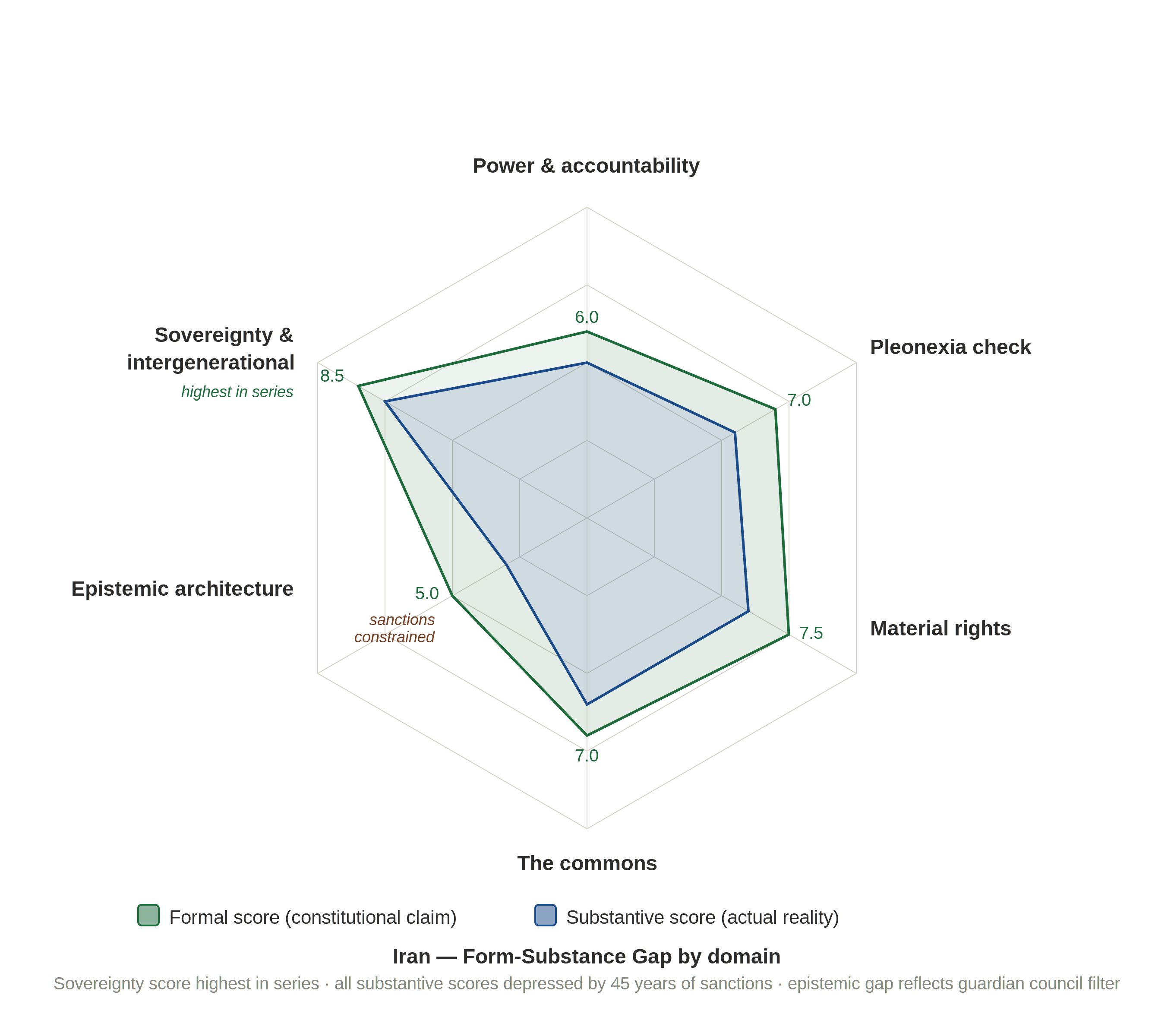
Figure 2. Iran — Form-Substance Gap by domain · sovereignty scores highest in series · all substantive scores must be read against 45 years of comprehensive sanctions · epistemic gap reflects guardian council filter rather than totalitarian enclosure
III. Domain Assessments
A methodological note before the domain assessments: every substantive score in this assessment must be read against the analytical constraint that 45 years of comprehensive economic sanctions have imposed on Iranian governance capacity. The sanctions are not a background condition. They are the primary determinant of Iran’s material rights delivery, commons management, epistemic architecture, and sovereignty domain outcomes. An honest assessment asks not only what Iran has achieved but what it has achieved under conditions that no comparable polity in the series has faced. The methodology applied to Cuba in the series — distinguishing governance failures from sanction-imposed constraints before attributing outcomes to governing quality — applies here with even greater analytical weight.
Domain 1: Power Structure and Accountability
Formal: 6.0/10 Substantive: 5.0/10 Gap: Moderate gap — genuine electoral competition within guardian council filter · the ethical council analysis
The Islamic Republic’s formal accountability architecture is the most analytically misrepresented in the Western discourse on Iran. The standard Western characterization presents the Iranian system as straightforward theocracy — a religious dictatorship in which clerical power determines all outcomes and elections are performances. The documented institutional reality is considerably more complex.
Iran holds competitive elections for the presidency, the parliament (Majlis), the Assembly of Experts, and municipal councils. These elections produce genuinely different outcomes: the reformist Mohammad Khatami’s two presidential terms (1997-2005) produced measurable changes in domestic social policy and foreign policy orientation; the hardline Mahmoud Ahmadinejad’s terms (2005-2013) reversed many of those changes; the moderate Hassan Rouhani’s terms (2013-2021) produced the nuclear agreement with Western powers that the US subsequently abandoned; the 2024 election of the reformist Masoud Pezeshkian over the hardline Saeed Jalili demonstrated that genuine popular preference can determine electoral outcomes when the guardian council permits both tendencies to run. These are not the outcomes of a system in which clerical power determines all results. They are the outcomes of a system in which genuine popular preferences are filtered rather than overridden.
The filtering mechanism — the Guardian Council’s authority to disqualify candidates before elections — is the system’s primary Form-Substance Gap in this domain. The Council has used this authority to exclude reformist candidates whose platforms it finds incompatible with the constitutional framework, producing electoral choices that are genuine among the permitted range but constrained before that range is established. The framework names this honestly: it is not electoral democracy in the Western procedural sense. It is a system in which the demos votes genuinely among a filtered field, and in which the filtering serves both the constitutional integrity function its architects intended and the factional interest function that any institution with selection power is vulnerable to.
The velayat-e faqih — the guardianship of the jurist, the principle giving the Supreme Leader ultimate constitutional authority — is most honestly understood not as theocracy in the Western sense but as an ethical council with oversight authority. The framing deserves elaboration. The Confucian tradition’s examination system made the same argument: governance requires specific knowledge and moral formation that electoral popularity does not select for, and the selection mechanism should test for these qualities rather than for the ability to win a popularity contest. The Iranian constitutional architecture makes a cognate argument in Islamic jurisprudential terms: the holder of ultimate authority should possess deep knowledge of Islamic law and ethics, demonstrated independence from worldly material interest, and the moral authority that comes from a lifetime of scholarship. This is not obviously inferior as a governance criterion to the ability to raise campaign finance and win media exposure.
The Guardian Council’s redistributive mandate is a dimension the Western account systematically omits. The council and the Supreme Leader’s office have consistently intervened in Iranian political economy on the side of redistribution rather than capital accumulation: Khomeini’s original positions on land reform, the nationalization of major industries, and the provision of basic services to the rural and urban poor were explicitly anti-oligarchic in their economic logic. Ahmadinejad’s cash transfer program — direct monthly payments to Iranian households — was explicitly redistributive and reached rural and lower-income populations that the pre-revolutionary economy had excluded. The framework’s Domain 2 analysis will develop this point, but it belongs in the accountability domain as well: the oversight function of the guardian architecture has included, at various points, genuine resistance to the private accumulation dynamics that the IRGC’s economic empire represents.
Domain 2: The Pleonexia Check
Formal: 7.0/10 Substantive: 5.5/10 Gap: Moderate gap — constitutional anti-accumulation mandate genuine · IRGC economic empire the primary oligarchic vector
The Islamic Republic’s founding constitutional commitment to economic justice is documented and substantive. Articles 43 and 44 of the 1979 constitution mandated the elimination of poverty, equal distribution of income, the prohibition of monopoly, and state ownership of major industries to prevent private capital concentration. These were not rhetorical provisions. They reflected the specific strand of revolutionary Islamic political economy associated with Ali Shariati and the Islamic left — a tradition that synthesized Islamic social teaching with Third World anti-colonial political economy in ways that placed it closer to the Basic Law’s commons and anti-accumulation architecture than to either Western liberalism or Soviet state socialism.
The oil revenue management question is the domain’s central exhibit. Iran nationalized its oil in 1951 under Mossadegh and re-nationalized it after 1979. The National Iranian Oil Company is state-owned. Oil revenues fund the state budget. The specific mechanism through which Norway built its sovereign wealth fund — capturing petroleum rents for the population rather than allowing private appropriation — is the same principle that the Islamic Republic has maintained against sustained external pressure to liberalize, privatize, and integrate into the Western financial architecture. Norway did this under favorable conditions. Iran did it under the most comprehensive sanctions regime in modern history. The achievement deserves the same analytical credit the framework gives Norway’s fund, scaled by the conditions under which it was maintained.
The IRGC economic empire is the domain’s primary oligarchic vector and must be named honestly. The Islamic Revolutionary Guard Corps has, over four decades, accumulated control over significant portions of the Iranian economy: construction, telecommunications, oil and gas, and import-export sectors. This is the Michels dynamic — the organizational capture of economic resources by the institution that succeeded in building and maintaining state power — operating in an Islamic Revolutionary context with the same structural logic it operates in every context. The IRGC’s economic position creates the same conflict of interest that the framework identifies in every comparable case: an institution whose formal mandate is state security whose actual interests include the protection of its own economic empire against both external competition and internal accountability. This is a genuine pleonexia vector that the formal anti-accumulation architecture has not successfully contained.
Domain 3: Material Rights
Formal: 7.5/10 Substantive: 6.0/10 Gap: Moderate gap — HDI 0.799 above world average · achieved under 45 years of sanctions · gender gap the domain’s primary structural deficit
Iran’s material rights delivery record is the assessment’s most analytically important exhibit against the Western framing, because it is documented by sources that have no interest in flattering Iranian governance. Iran’s Human Development Index in 2023 is 0.799 — above the world average of 0.744, placing it in the high human development category, achieved and maintained under the most comprehensive peacetime economic sanctions in modern history. This number cannot be explained by the standard Western account of Iranian governance as a theocratic dictatorship primarily engaged in oppressing its population.
The universal health insurance architecture covers over 42 million Iranians through multiple funds: the Rural and Nomadic Insurance Fund, the Government Employees Fund, the Universal Health Insurance Fund, and supplementary funds covering war veterans, seminary students, prisoners, and foreign nationals. This is a genuine universal coverage architecture, built and maintained under conditions in which pharmaceutical imports have been systematically blocked by sanctions, medical equipment has been denied, and the currency that pays for imported medical supplies has been devalued by financial warfare. UNICEF’s 2024 Iran report documents that the unilateral sanctions have severely restricted trade and investment and forced the government to rely heavily on fiscal stimulus and subsidies to maintain service delivery. The material rights achievement documented by the HDI is in spite of the sanctions, not because of favorable external conditions.
The gender equality dimension is the domain’s primary structural deficit and requires the deepest available historical grounding before the framework can assess it honestly. The Gender Inequality Index remains a significant concern in Iranian governance, acknowledged explicitly in the UNDP’s own Iran country reports. Women’s access to education is strong — Iranian universities have majority female enrollment, and female literacy rates are high. Women’s access to employment and public life is constrained by legal and social restrictions that the framework scores as a genuine Form-Substance Gap: the formal constitutional commitment to human dignity and the substantive restriction of women’s choices in dress, movement, and professional participation.
The veil itself requires a genealogical correction before its current deployment can be accurately assessed. David Graeber’s Debt: The First 5,000 Years documents that in the ancient Near East — Mesopotamia, Assyria, the Babylonian world — the veil was originally a marker of status and protection, not of modesty or religious obligation. The Assyrian Middle Laws of approximately 1200-1400 BCE explicitly regulate who may and may not veil: free women of respectable families were required to veil in public as a signal that they were not available for the debt-slavery market. Enslaved women and prostitutes — women whose bodies were already available as economic assets — were forbidden from veiling. The veil protected women from the reach of creditors; it was the mark of a woman whose father or husband had sufficient social standing that she could not be sold into bondage. This function is inseparable from the specific historical moment Graeber identifies: the patriarchal revolution of roughly 1700 BCE in the ancient Near East, when the earlier more egalitarian Bronze Age urban cultures gave way to the militarized, debt-saturated, patriarchal social orders whose institutional forms persist. Before this revolution, women of high status exercised genuine public intellectual and spiritual authority — Enheduanna, the Akkadian high priestess writing around 2300 BCE, is the first named author in human history. After it, that authority became progressively impossible. The veil’s original function was protective. Its subsequent inversion — from a marker of status and protection into a marker of control and enclosure, from this woman is not available for purchase to this woman’s body and appearance are not available for public view — is the zhengming corruption in material culture: the same garment, the same gesture, the substance entirely reversed.
The mandatory hijab as institutionally enforced by the Islamic Republic rests on a specific theological argument whose internal contradictions the framework’s zhengming discipline requires naming. The argument is that women must cover because the sight of them produces impure thoughts in men, and men cannot be held responsible for thoughts that are involuntarily provoked. This construction simultaneously removes male moral agency entirely, holds women responsible for male psychological states they do not control, and requires state coercive apparatus to enforce a solution to a problem that the doctrine itself defines as involuntary and therefore unenforceable at the level of thought. A genuine strand within Islamic jurisprudence recognizes this impossibility: Allah does not impose accountability for thoughts that arise involuntarily, and accountability attaches to actions rather than to the internal mental states that precede them. This strand is in direct tension with the institutional enforcement of hijab as a thought-policing mechanism. The deeper contradiction is practical: if the sight of a woman produces thoughts that preclude normal social functioning, how do families form, how do partners meet, how does the social fabric the patriarchal order is designed to protect actually sustain itself? The doctrine collapses under its own weight when followed to its conclusion. The veil requirement is not unique to Islam — Christian women were required to cover their hair in worship contexts across centuries, the requirement persisting in traditional settings to the present, rooted in the same ancient Near Eastern patriarchal genealogy that Paul’s letters to the Corinthians transmitted into Christian practice. The universal character of the requirement across Abrahamic traditions confirms its origin in the patriarchal revolution rather than in any specific theological revelation.
The Mahsa Amini protest movement of 2022 — one of the most significant social movements in the Islamic Republic’s history, involving women publicly removing the mandatory hijab at enormous personal risk — is the demos exercising the accountability function that the guardian republic architecture has not successfully suppressed. The movement did not achieve its stated objectives. It demonstrated that the Iranian population’s independent judgment function is intact — that the brain has not been removed from the frog. But its specific character — the specific act of the unveiled hair, the specific symbolic force of women moving their hands through their hair in public — reflects something deeper than political protest. It reflects a civilizational memory encoded in Hafez’s poetry, in the Zoroastrian tradition’s relationship to the female body, in the Achaemenid court’s absence of mandatory veiling, that the revolutionary Islamic governance model has never fully succeeded in suppressing because it is older than Islam in Iran, older than the patriarchal revolution that produced the veil’s protective function, reaching back to the Enheduanna moment when a woman’s public intellectual authority was simply assumed. The mandatory hijab sits on top of a civilizational substrate that has its own, much older, relationship to female presence and female beauty. The protest is the substrate asserting itself.
Domain 4: The Commons
Formal: 7.0/10 Substantive: 6.0/10 Gap: Moderate gap — petroleum commons managed as national resource · water commons under pressure · cultural commons partially enclosed by revolutionary censorship
The petroleum commons is the domain’s primary achievement. From the 1979 revolution to the present, the Islamic Republic has maintained state ownership and management of Iran’s petroleum resources against sustained external pressure to privatize, liberalize, and integrate into the Western financial architecture. The specific external pressure has included: the systematic blockade of Iranian oil exports through sanctions, reducing Iran’s oil revenues to a fraction of their potential; the assassination of Iranian nuclear scientists as part of a campaign to prevent Iran from developing sovereign nuclear capability; and the 2026 military strikes that targeted Iranian infrastructure including the oil sector. The commons management has been maintained under these conditions. The achievement is real.
The Persian cultural commons is the domain where the assessment’s most distinctive finding lies. The Islamic Republic’s revolutionary censorship has enclosed certain dimensions of the cultural commons — music, cinema, literature, and the visual arts have all been subject to restrictions that the framework scores as genuine Form-Substance Gap violations between the constitutional commitment to Islamic culture and the substantive suppression of cultural expression that does not conform to the revolutionary model. Iranian cinema — which produced some of the world’s most admired films under precisely these conditions, Abbas Kiarostami’s work being the most celebrated internationally — demonstrates the paradox the assessment must name: the censorship created the constraint that shaped the aesthetic; the constraint produced the art; the art escaped the censorship through the same intelligence and resilience that Iranian culture has always brought to the obstacles placed in its path.
The water commons is under pressure from the same combination of factors visible in India: aquifer depletion, agricultural overextraction, climate disruption of rainfall patterns. Iran’s geography — a high plateau ringed by mountains, with most of the population concentrated in arid and semi-arid zones — makes water management a civilizational priority that predates the Islamic Republic by millennia. The qanats — the ancient underground irrigation channels that have managed water distribution across the Iranian plateau for three thousand years, a UNESCO World Heritage site — represent the most sophisticated pre-industrial water commons management system in history. Their continued operation alongside modern water infrastructure represents the intergenerational covenant in its most literal engineering form.
Domain 5: Epistemic and Civic Architecture
Formal: 5.0/10 Substantive: 3.0/10 Gap: Large gap — internet filtering and media restrictions genuine · epistemic commons is constrained not destroyed · the brain is in the frog
The epistemic domain is where Western analysis of Iran is most distorted and where the framework’s corrective is most analytically important. The standard Western account presents the Iranian information environment as a totalitarian epistemic closure equivalent to North Korea. The documented reality is more complex, more interesting, and more analytically instructive.
Iran has extensive internet filtering: access to many Western social media platforms, news sites, and information sources is blocked or heavily restricted. Press freedom scores are poor. Journalists, bloggers, and social media users have been imprisoned for their content. These are genuine epistemic commons violations that the framework scores honestly as large Form-Substance Gaps between the constitutional commitment to free expression and the substantive management of information flow.
Against this, the epistemic commons that exists within the Iranian information space is not the managed monoculture that the Norwegian assessment documented post-2022. Iranians debate, argue, satirize, and challenge authority with a ferocity and sophistication that the sanctions regime has if anything intensified rather than suppressed. The Telegram channels, the VPN networks, the underground cinema, the samizdat poetry — these are the cultural resistance mechanisms of a population that knows its information environment is managed and has developed the tools to navigate around the management. The Norwegian population after 2022 performs the consensus it has been convinced it holds. The Iranian population knows it is performing compliance while holding its own views in reserve. These are different epistemic conditions. The first is more dangerous to genuine democracy than the second.
The Mahsa Amini moment requires the evidentiary precision the framework’s zhengming discipline demands. The standard Western account presents the police as directly responsible for her death in custody in September 2022. The documented record is more contested: CCTV footage from the detention facility did not confirm the direct physical assault that initial accounts alleged, and the official cause of death was attributed to a pre-existing brain condition. Independent verification of either account is difficult given the political stakes for both sides. The framework names this honestly rather than inflating the exhibit for analytical convenience.
What is not contested is the significance of what her death crystallized. The protest movement that followed was not primarily about one woman’s death in one police encounter. It was about the accumulated weight of decades of mandatory hijab enforcement imposed on a population whose civilizational identity predates Islam by millennia — the anachronism of a practice whose enforcement requires the coercive apparatus of the state to maintain in a population that would not comply with it voluntarily at the rate the state requires. A governance architecture that depends on coercion rather than consent to maintain a cultural practice has lost the mandate of heaven for that practice, whatever its formal constitutional status remains. The underlying factors are unresolved. They will produce further manifestations.
The sovereignty misallocation dimension is the domain’s most strategically acute finding and the one the Western account most completely ignores — because naming it requires crediting the Islamic Republic with a strategic rationality its caricature cannot accommodate. The Gasht-e Ershad — the morality police whose encounter with Mahsa Amini produced her death in custody — represents a specific allocation of state coercive resources, intelligence attention, and popular legitimacy to the enforcement of a dress code at a moment when Israeli intelligence had penetrated Iranian society deeply enough to conduct assassinations of nuclear scientists, the Stuxnet cyberattack, and ultimately the coordination of the 2026 military strikes. Every hour the morality police spent identifying uncovered hair was an hour not spent identifying Mossad assets. Every unit of popular legitimacy consumed by hijab enforcement was a unit unavailable for the sovereignty defense mobilization that the survival of the Islamic Republic required. The velayat-e faqih architecture was designed as a sovereignty protection mechanism — to build a state resistant to the external penetration that destroyed Mossadegh. The morality police apparatus is a gift to the penetrators: it consumes the internal legitimacy and coercive resources that sovereignty defense requires, while generating the domestic discontent that external destabilization operations exploit. The Islamic Republic that cannot stand the sight of a woman’s uncovered hair may lose its sovereignty because it was looking the wrong way. This is not an argument from outside the guardian republic’s own founding logic. It is an argument from within it: the founders built the structure to defend Iranian sovereignty. The morality police undermines that defense. The Form-Substance Gap is internal to the Islamic Republic’s own stated purpose.
The specific comparison with Norway is the domain’s analytical gold. Norway’s epistemic commons was the most genuinely open in the series before 2022. After 2022 it has been enclosed by NATO hive mind pressure into a managed monoculture where dissent is investigated by the intelligence service and every outlet says the same thing. Iran’s epistemic commons has been constrained by the guardian republic architecture since 1979. But the Iranian population’s capacity for independent political judgment — demonstrated in the 2024 election, the 2022 protests, the 2009 Green Movement, and the sustained underground cultural life — exceeds the Norwegian population’s demonstrated capacity to maintain independent judgment against NATO alignment pressure. The assessment names this without equivocation: epistemic freedom is a spectrum, constraint has many forms, and the constraint that operates through voluntary consensus is in some respects more dangerous to democratic governance than the constraint that operates through visible restriction.
Domain 6: Sovereignty and the Intergenerational Covenant
Formal: 8.5/10 Substantive: 7.5/10 Gap: Small gap — highest sovereignty score in the series · resource nationalization maintained under military assault · Cyrus to Mossadegh to the Islamic Republic
Iran scores the highest sovereignty rating in the series. This is not an analytical artifact. It is the direct consequence of a specific and sustained political choice: the determination to govern Iranian resources, Iranian territory, and Iranian political life in accordance with Iranian decisions rather than external ones, maintained against the most comprehensive economic warfare and the most sustained military pressure that any polity in the series has faced.
The sovereignty continuity from Cyrus to Mossadegh to the Islamic Republic is the genealogy in its most compressed form. Cyrus the Great asserted Persian sovereignty over the Near East while practicing the tolerance documented in the Cylinder. Mossadegh asserted Iranian sovereignty over Iranian petroleum while practicing the democratic governance that Operation Ajax destroyed. The Islamic Republic asserted Iranian sovereignty over its nuclear program, its foreign policy, its domestic governance, and its regional relationships while sustaining the sanctions, the assassinations, and now the military strikes that the assertion has provoked. The thread connecting these three moments is not religious ideology. It is the consistent Iranian insistence that Iranian affairs should be governed by Iranians.
The monetary sovereignty dimension is genuine and consequential. Iran has maintained an independent currency, an independent central bank, and an independent monetary policy against the sustained attempt to integrate it into the dollar-denominated global financial architecture. The sanctions have imposed enormous costs on this independence — currency devaluation, inflation, restricted access to international financial systems. The independence has been maintained. The framework’s Domain 6 analysis in every previous assessment has scored monetary sovereignty as the primary indicator of genuine sovereignty. By that criterion, Iran’s sovereignty score exceeds every other polity in the series except Norway, which maintains it under favorable conditions.
The 2026 US-Israeli strikes represent the current sovereignty domain exhibit — and they carry an analytical juxtaposition that the framework must name precisely. The Islamic Republic of Iran has a written constitution: 177 articles, a specific institutional architecture, a defined amendment procedure, a constitutional court, and a specific enumeration of rights and duties. It is, by the framework’s formal analysis, a constitutional republic. Imperfect, contested, with genuine Form-Substance Gaps between its formal commitments and its substantive operation — but constitutionally governed, on its own territory, within its own constitutional framework.
The state that conducted the 2026 strikes has no congressional declaration of war authorizing them. It has no UN Security Council resolution sanctioning them. It has no treaty provision whose terms Iran had violated that would trigger collective defense obligations. Its partner in those strikes — Israel — is the only developed democratic state in the world with no written constitution at all, and with no legally defined territorial boundaries, a deliberate founding condition that the ICJ’s 2024 advisory opinion on the illegality of the occupation placed within the frame of international law’s most fundamental norms. A state without a constitution and without defined borders acted in coordination with a state whose constitutional constraints on executive war-making have been progressively hollowed out, to strike a constitutional republic operating within its own borders. The Security Council chamber did not convene in emergency session. It sat beside the Cyrus Cylinder and was quiet.
The juxtaposition is the assessment’s most precise single exhibit for the framework’s central argument about the Western liberal order: its claim to represent constitutional governance against authoritarian threat is undermined by the documented reality that its enforcement mechanism operates outside the constitutional constraints it claims to be defending. The constitutional republic is under assault by a state without a constitution in any operationally meaningful sense of that word. The Cylinder in the hallway watches. The irony has been naming itself since 1971.
The intergenerational covenant is honored in a dimension no other polity in the series honors: the explicit connection between contemporary Iranian governance and a civilizational inheritance that reaches back not decades or centuries but millennia. The Persian New Year — Nowruz — celebrated at the spring equinox, predating Islam by centuries, maintained through the Islamic Republic with state recognition and national celebration, connects contemporary Iranians to the same seasonal rituals their ancestors performed in Persepolis. The Zoroastrian fire temples still functioning in Yazd. The recitation of Hafez at family gatherings. The qanats distributing water through the plateau as they have for three thousand years. These are the intergenerational covenant in its most immediate and most beautiful form: the substance of civilization being preserved across conquest, revolution, and siege, not because a government mandated it, but because the people refused to let it go.
IV. Synthesis: The Constitutional Guardian Republic Under Siege
The zhengming name for Iran in this framework is: the constitutional guardian republic under sustained imperial siege. Each word earns its place.
Constitutional because the governance architecture is a written constitution with genuine institutional complexity: elected president, elected parliament, elected Assembly of Experts, appointed Guardian Council, Supreme Leader — a system of multiple institutions with overlapping authorities and genuine factional competition among them. Not a simple dictatorship. Not a theocracy in the sense of divine law directly administered. A specific and unusual constitutional formation whose logic is coherent once its sovereignty defense rationale is understood rather than dismissed.
Guardian republic because the filtering mechanism — the Guardian Council’s authority over candidate eligibility — is genuinely more analogous to an ethical council with oversight authority than to the single-party filtration that the Western account implies. The council filters for specific qualifications rather than party membership. It has permitted genuine reformist candidates to run and win at multiple points in the republic’s history. It has also exceeded its legitimate filtering function to protect factional interests. Both things are true. The framework names both.
Under sustained imperial siege because the external constraint on Iranian governance is not a background condition. It is the primary determinant of every material outcome the assessment has measured. The sanctions that block pharmaceutical imports, devalue the currency, restrict food access, and prevent normal economic development are not a response to Iranian aggression. They are a response to Iranian sovereignty assertion — the same sovereignty assertion that Operation Ajax was designed to destroy in 1953 and that the 2026 strikes were designed to destroy in the present. The assessment cannot be honest about Iran’s governance quality without being honest about the conditions under which that governance operates.
The Norway comparison is the series’ most analytically precise exhibit for the resource curse as political choice. Both Norway and Iran asserted sovereignty over their petroleum resources against sustained external pressure. Norway did so within NATO membership, with Western diplomatic support, in favorable market conditions, without military threat. Iran did so after a CIA-MI6 coup destroyed its first attempt, rebuilt the capability after 1979, maintained it through 45 years of comprehensive sanctions, sustained it through the assassination of its nuclear scientists, and continues to maintain it while under active military attack. The material outcomes differ enormously: Norway’s $2 trillion sovereign wealth fund against Iran’s sanctions-constrained economy. The political choice is identical. The conditions are maximally different. The framework names this precisely: the resource curse is a political choice, and the conditions under which the choice is made determine the outcome more than the choice itself.
The substrate dimension analysis that the France-Germany comparison revealed elsewhere in the series finds one of its most important applications in the Iran case. Iran’s substrate carries two paired analytical features that together produce the specific resilience under pressure that the Western strategic framework cannot model and therefore consistently fails to predict. The first is the martyr substrate: the Shia tradition rooted in Karbala, in Hussein ibn Ali’s death in 680 CE, in the specific theological understanding that the martyr’s death is not a defeat but a consecration — not the end of the movement but its transformation into something more powerful and more durable than it was before the martyrdom. The operational consequence is precise and empirically documented. When Qasem Soleimani was killed in January 2020, the Western analytical establishment expected organizational paralysis and strategic retreat. The IRGC held the largest funeral procession in Iranian history and conducted a missile strike on Ain al-Assad air base within days. When Hassan Nasrallah was killed in September 2024, Hezbollah did not collapse. It reorganized, quickly and coherently, around the martyrdom that his death had produced. The hero tradition’s strategic logic — decapitation produces paralysis, targeted assassination degrades organizational capacity, leadership elimination creates succession crisis — is not merely ineffective against the martyr substrate. It is actively counterproductive: every eliminated leader feeds the martyr substrate rather than depleting it, every assassination risks producing a Karbala that consecrates the organization’s continuation more powerfully than the living leader’s presence had.
The second paired feature is the institutional filter: the guardianship model as a structured mechanism for ensuring that leadership succession produces qualified replacements rather than factional chaos. This is the balancing dimension that the martyr substrate analysis requires to be analytically complete. Organizational resilience under pressure is valuable only if the regenerated leadership is genuinely qualified to lead. The martyr substrate provides the resilience. The guardian council filter provides the coherence of the regeneration. The velayat-e faqih architecture — designed, as the assessment has documented, as a sovereignty protection mechanism responding to 1953 — simultaneously serves as a leadership qualification filter whose specific criteria, grounded in Islamic jurisprudential tradition, constrain what any individual can credibly claim as a basis for authority. The filter is imperfect. The 2021 presidential election documented its most serious failure mode: the Guardian Council disqualified virtually all credible reformist and centrist candidates, producing an artificially narrowed field that served factional rather than filtering purposes. The same filter that failed in 2021 permitted the 2024 election in which the reformist Masoud Pezeshkian defeated the hardline Saeed Jalili in genuine popular competition. A filter that can produce both outcomes in consecutive election cycles is not a rubber stamp. It is a contested institutional space whose performance depends on the balance of forces within the filtering body. The filter’s failure mode — captured by a specific political tendency that defines qualification in its own interest — is the Michels dynamic applied to the guardianship institution. The filter’s functioning — producing leadership succession that meets a defined qualification standard even under conditions of sustained external assault — is the specific institutional achievement that the Western analytical framework, which has no category for qualified-leadership selection outside elections, cannot recognize as an achievement. Elinor Ostrom’s commons governance design principles require collective choice arrangements that allow the community to select and modify the rules governing the commons. The guardianship model is a specific answer to that requirement: jurists selected within a defined theological and legal tradition, with criteria that the tradition itself constrains, producing leadership that is accountable to a standard of qualification rather than merely to a standard of popular approval. The answer is imperfect. The question it is answering is the right question.
The martyr substrate and the institutional filter together produce what no Western analytical model predicts: a polity that is more resilient under the most sustained external assault in the series than it would be under favorable conditions, because the assault activates rather than depletes the organizational energies that the substrate contains. This is the Iran assessment’s most important finding for the remaining assessments in the series, and specifically for the Israel assessment whose planning is already underway in the audit. The hero tradition and the martyr tradition are not merely different cultural approaches to leadership. They are structurally incompatible strategic logics whose conflict produces systematically different outcomes than either party’s strategic planning accounts for. The hero tradition’s decapitation strategy produces Karbala. Karbala produces a Shia tradition fourteen centuries old and structurally resistant to the strategy that produced it. The strategic incomprehension is not accidental. It is produced by the specific character of the analytical framework that the hero tradition cannot revise from within itself because the revision would require acknowledging that the martyr tradition’s organizational logic is more durable than its own.
The Aeschylean distortion that the preamble named finds its final form in the synthesis. The Persian Wars were, as Gore Vidal’s Cyrus Spitama documents from the inside, substantially caused by Greek political intriguing at the Persian court, by Athenian imperialism in Ionia, and by the specific provocations that produced the Persian response. The empire whose fleet sailed west was responding to a Greek intervention that had burned Sardis. The US military whose aircraft struck Iranian territory in 2026 was responding to an Iranian regional presence that had itself developed in response to US military encirclement through bases in Iraq, Afghanistan, Saudi Arabia, Kuwait, Bahrain, Qatar, and the UAE — a military presence that surrounds Iran with hostile force while presenting Iran as the aggressor. The historical parallel is not coincidental. The superpower at the center of the empire presents its response to peripheral provocation as defensive action against oriental aggression. Aeschylus and CNN perform the same function. The framework refuses both.
The constitutional juxtaposition is the assessment’s closing exhibit and its most analytically precise. The Islamic Republic of Iran is a constitutional republic: 177 articles, genuine institutional architecture, genuine electoral competition within a filtered field, a written enumeration of rights and duties, a constitutional court with real jurisdiction. A constitutional republic — imperfect, contested, with genuine Form-Substance Gaps — but constitutionally governed. The state that conducted the 2026 military strikes on that constitutional republic’s territory did so without congressional authorization, without UN Security Council sanction, without treaty obligation that Iran had violated, under an executive power claim whose constitutional basis has been progressively hollowed out by the same oligarchic capture the US assessment documented. Its partner in those strikes — Israel — is the only developed democratic state in the world without a written constitution at all, a deliberate founding choice that has never been corrected, rooted in the impossibility of constitutionally defining borders for a state whose founding ideology required their permanent expansion. Israel has never legally defined its territorial boundaries — not in 1948, not in 1967, not in any subsequent legal instrument — a constitutional vacuum whose direct consequence is the two-tier legal system in which Israeli settlers on occupied Palestinian territory are governed by Israeli civilian law while the Palestinian population on the same territory is governed by military law. The ICJ’s 2024 advisory opinion declared this occupation illegal under international law. A state without a constitution and without defined borders, acting in coordination with a state whose constitutional constraints have been hollowed out, struck a constitutional republic in its own territory. The Western liberal order’s claim to represent constitutional governance against authoritarian threat requires this sentence to not be true. The documented record requires it to be stated.
The Cyrus Cylinder sits in the hallway. The Security Council chamber is on one side. The strikes were ordered by people who walk past it. The civilization whose founding declaration of human understanding, tolerance, courage, compassion, and human liberty has been in that hallway since 1971 is the civilization whose libraries, universities, and cultural infrastructure have been bombed. The framework names this without equivocation, without flattery, and without the Aeschylean distortion that has made the naming difficult for two and a half millennia.
Hafez watches. He has been watching for seven hundred years. He will be watching long after the Security Council chamber has become a museum piece and the bombs are historical footnotes. The verses are memorized. The qanats run. Nowruz comes at the spring equinox. The civilization continues.
The Cylinder sits in the hallway. The irony names itself.
L’dor v’dor. From generation to generation.
Salva rerum substantia. The substance of the thing being preserved.
Zhengming. The rectification of names.
The Freeze-Frame Revolution · squirrelbrain77.substack.com · June 2026
Assessment No. 7 of 33 · Cluster C5: Petrostate Variants · The European Union closes the series